



If you’re an adult in the US and wonder, “What does Medicaid cover for dental for adults?” Medicaid programs are required to cover children and youth under the age of 21. But they don’t have to cover adults’ dental care.
Sadly, the United States is experiencing a dental crisis, as highlighted in a May 16, 2024, hearing of the Senate Committee on Health, Education, Labor, and Pensions (HELP). The statistics highlighted a growing spate of poor oral health among US adults, especially among low-income households.
Based on similar discoveries before, during, and after the hearing, state policymakers and advocates are taking the initiative to provide adult dental benefits. However, states choose the class or number of dental health services and beneficiaries they cover for adults. Often, states update the list of covered needs annually based on available funding and other factors.
Here’s the post to observe available oral care funding opportunities for adults across the US states based on recent data.
What Does Medicaid Cover for Dental for Adults Across the United States?
US states experienced one of the most significant expansions of Medicaid adult dental benefits between 2020 and 2022. The expansion has continued through the following two years to newer services across the country.
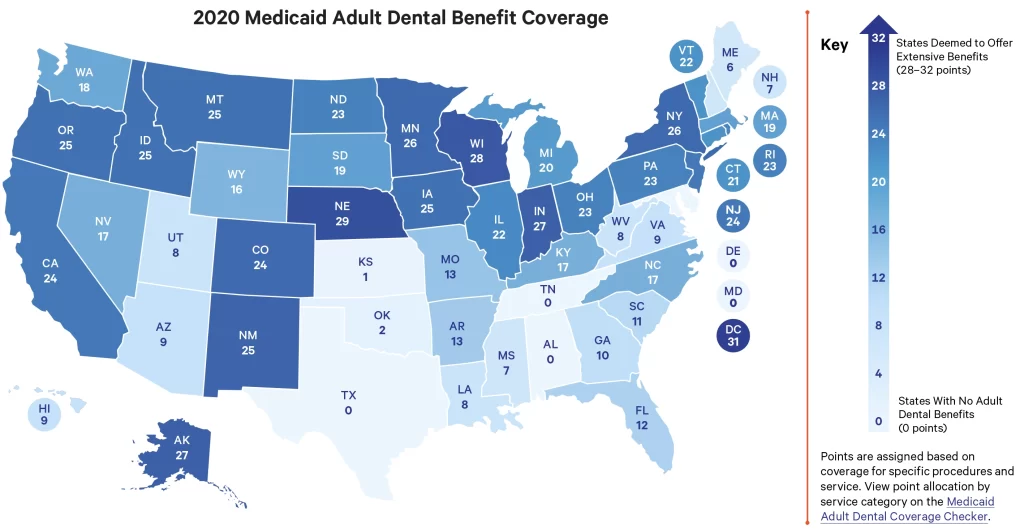
Much of the information in this post is from The Coverage Checker, an interactive tool designed by the American Dental Association Health Policy Institute (ADA HPI) and related organizations to understand each state’s dental benefits package.
The document includes data from surveys completed in 2020, 2022, and 2023, with relevant data answering incoming or resident Americans wondering, “What does Medicaid cover for dental for adults?” The following is some vital information we’ve gathered on the subject.
- More US states are offering extensive Medicaid adult benefits to all adult beneficiaries.
In 2020, only three states and the District of Columbia offered a comprehensive dental benefit to the largest group of Medicaid adult beneficiaries between 21 and 64.
As of this report, that category has nine member states, including Alaska, Hawaii, Iowa, Maine, Montana, New Jersey, Tennessee, Wisconsin, and the District of Columbia.
- More states expanded their Medicaid coverage for adults significantly between 2020 and 2023
Twenty-six states expanded their dental benefit offerings between 2020 and 2023. Four states – Kansas, Michigan, North Dakota, and South Dakota – expanded their benefits twice within that period. In 2023, 12 states expanded their benefits offerings by one or more services (such as cleaning, complete dentures, and periodontal services).
The states with significant expansion of Medicaid coverage for adult dental care include Kansas, Kentucky, Hawaii, Tennessee, Maryland, and New Hampshire. Thanks to the improvements, Tennessee and Hawaii joined the list of states providing comprehensive dental Medicaid coverage for adults.
Read also: Top 5 Dental Insurance That Covers Invisalign
Based on these improvements, here’s how recent data answers the question, “What does Medicaid cover for dental adults across various US states?”
Kansas
By 2020, the state only offered emergency extractions since eliminating dental benefits in 2010. However, in October 2022, Kansas approved funding to cover dental care for adults, with additional coverage in 2023 and 2024 covering dentures, dental x-rays, and cleaning.
Other dental services available to Kansas citizens include fillings, crowns, periodontal (gum disease) care, and transportation to dental appointments.
Maryland
Effective January 1, 2023, all adult beneficiaries of Maryland’s Medicaid can now access diagnostic, preventive, restorative, endodontic, periodontal, and oral surgery services. In 2022, the state’s legislature conducted a successful Adult Dental Pilot program for adults between 21 and 64 dually eligible for both Medicaid and Medicare.
Following the program, the state approved dental benefits for adults in the state, alongside expanded benefits for pregnant and postpartum adults.
Michigan
Michigan implemented adult dental benefits in 2023 to include coverage for X-rays, cleanings, fillings, crowns, root canals, periodontal services, dentures, and extractions.
The developments came after the Michigan Department of Health and Human Services (MHHS) submitted a proposal to the legislature to redevelop the Medicaid adult dental benefit program in October 2022.
After legislative approval in December 2022, the MDHHS began rolling out improvements in January 2023, which included a significant increase in provider reimbursement rates.
Read also: Does Dental Insurance Cover Wisdom Teeth Removal?
New Hampshire
New Hampshire implemented a new adult dental benefit program starting in April 2023 that includes diagnostic, preventive, restorative, and oral surgery services. The program also covered dentures (for specific beneficiaries) with an annual benefit maximum of $1500.
Before then, the state offered an emergency-only Medicaid dental benefit to adults in its program. However, in 2019, Governor Chris Sununu signed a law that potentially opened the way for an expanded dental benefit care program.
The legislation also directed the New Hampshire Department of Health and Human Services to launch a designated working team to create extensive dental benefit packages for adults workable on a value-based care system.
Following years of sustained advocacy and work to create the benefit program, the state began offering a comprehensive benefit program for adults.
Tennessee
Starting January 1, 2023, Tennessee began covering diagnostic, preventive, restorative, endodontic, periodontal, prosthodontic, and oral surgical services (including extractions) on its Medicaid dental benefits program for adults.
In 2022, the state Medicaid agency announced that it would extend its dental coverage to include pregnant and postpartum beneficiaries. In 2023, the state expanded its dental benefit program to include all adults.
- On annual benefit maximums
As of 2023, at least 34 states placed no dollar limits on the amount or class of dental services that each Medicaid member can receive annually (after two new states joined the list in 2023 alone).
Fourteen states have an annual benefit limit of $1000 or greater (after 10 new states imposed the limit in 2023 alone). Lastly, 2 states continue to have an annual benefit limit of less than $1000.
- More coverage for certain adult groups across the US states
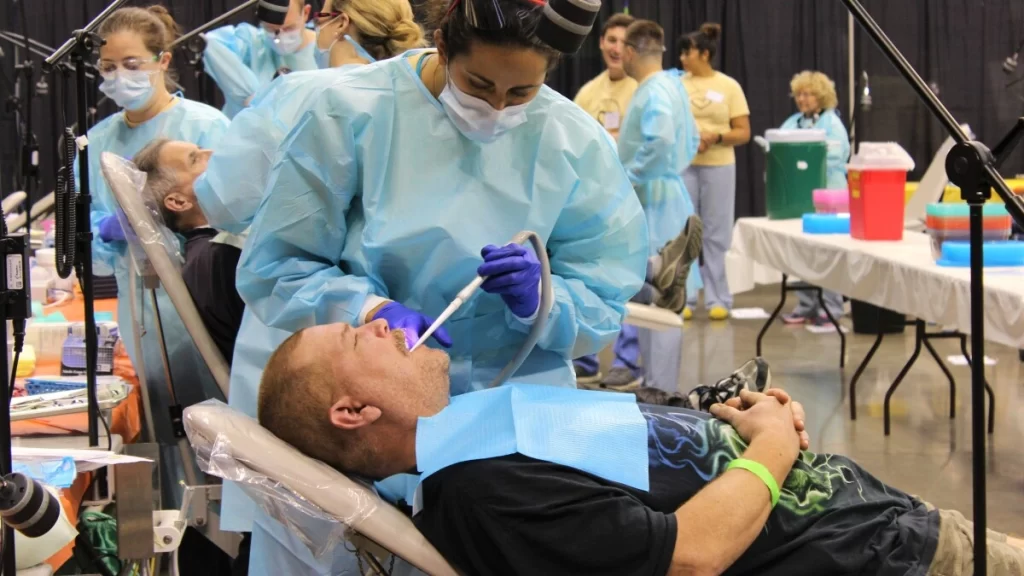
Acknowledging the special oral health care needs of a specific group of adult beneficiaries, some states chose to provide enhanced or extra services to these groups. They include pregnant and postpartum adults, adults with intellectual and/or developmental disabilities, those with certain health conditions, and those in long-term care.
In 2023, 20 states reported that they provide coverage to a specific group of beneficiaries over the available service coverage for adult beneficiaries between 21 and 64.
Read also: Does Blue Cross Medical Insurance Cover Dental Implants?
- More coverage expansions and improvements in 2024
States keep updating their adult dental coverage program. Six states (Connecticut, Kansas, Minnesota, Nebraska, Utah, and West Virginia) have either announced improvements or plans to do so shortly afterward. Other states are still considering legislation that may result in benefit improvements sometime in the future.
Conclusion
Dental health is a crucial part of people’s overall health. But while states are required to provide dental benefits to children and youths under 21 covered by Medicaid and the Children’s Health Insurance Program (CHIP), states choose whether to provide dental benefits to adults.
Considering the ailing dental crisis in the nation and the special oral health needs of a specific adult demography, many states are creating legislation that provides some form of dental benefit coverage to adults between 21 and 64.
While some states’ offers include a maximum dollar limit of $1000 for adult beneficiaries, others have a no-limit provision catering to the dental care of adult beneficiaries based on other conditions.
If you’re unsure where your state stands on the situation, kindly seek specific information from your state’s Medicaid agency for specific information that concerns your situation.